
 By:
By: 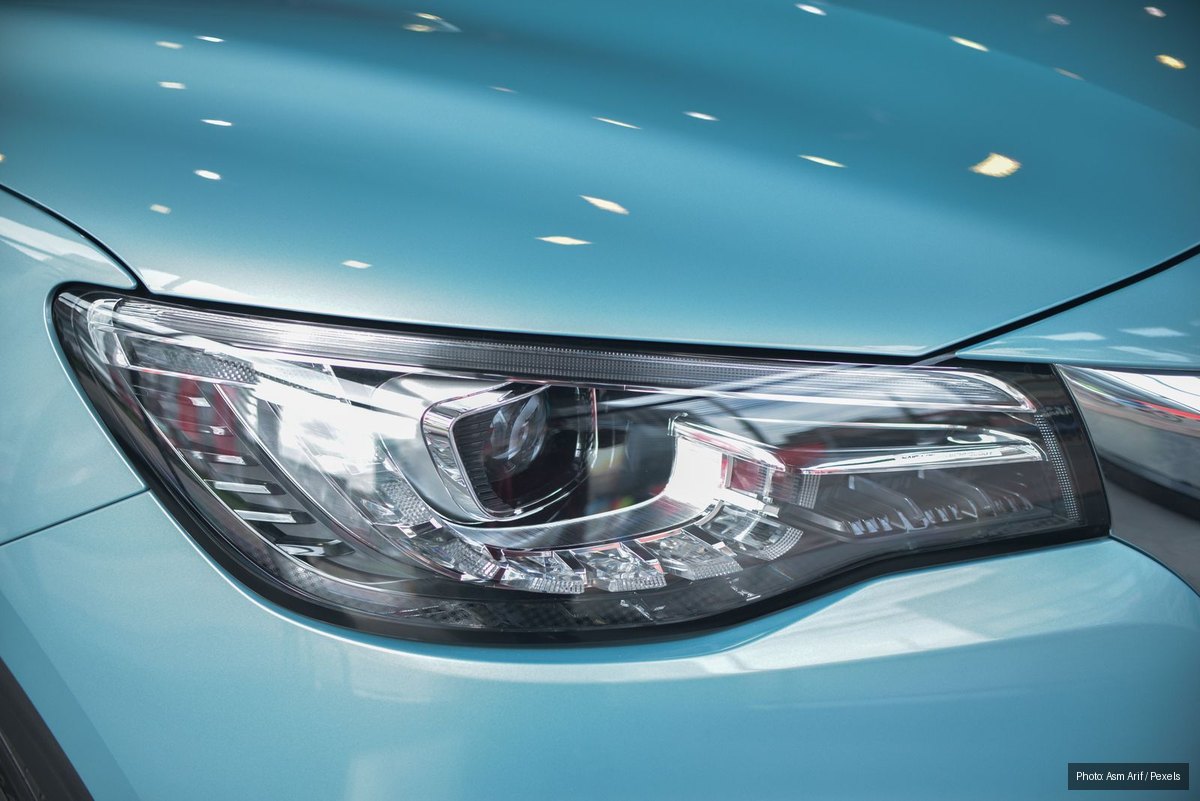
The short answer: at the factory, every pane of glass and both headlights are fitted in the same window, a month or two before the car's build date. Think of them as the car's "birth certificates". If one pane or one headlight is newer than the rest or newer than the car itself, that part was replaced, and that almost always means a past accident. It reads in a minute once you know where to look, and once you stop mistaking the date for the part number.
And straight to the main source of confusion: the number in the code is the last digit(s) of the YEAR, not "2146". A single digit repeats every 10 years, so you work out the decade from the age of the car itself. Glass on a 2018 car marked "7" or "8" means 2017/2018, not 2148 and not 2008.
Glass: where to look and how to read it
Where: the bottom corner of the pane, the maker's stamp (Pilkington, Saint-Gobain, AGC, Fuyao, and so on). The date is a row of dots + a number next to the logo. Don't confuse it with "DOT-577", the "AS1/AS2" markings, or the part number, none of those are the date.
- The number = the last digit(s) of the year. The decade comes from the age of the car (see above).
- The dots = the month, and the SIDE of the number = the half of the year (this part is reliable): dots before the number mean the first half (Jan–Jun); dots after the number mean the second half (Jul–Dec).
- The exact month (if you actually need it): the count runs 6→1 within each half. One caveat: different sources give the exact-month formula differently, so the half of the year from the dot side is reliable, but the exact month is best confirmed with the glass maker. For an accident check you don't need the exact month anyway.
- You'll also see another format: the number (year) + a month letter (A = January … L = December).
Headlights: the moulded "clock"
Where: the date is moulded into the plastic (not a sticker!), along the edge of the lens, in a corner, or on the back of the housing.
- The date is a little "clock": a ring of numbers 1–12 (the months), an arrow, and two digits for the year at the hub. The arrow points to the month. Example: arrow on "9", "21" at the hub → September 2021.
- ⚠️ Not every arrow is a date. A lone arrow with no numbered dial is a left/right side marker under the ECE standard, not a year. The date is only the arrow that sits inside a dial with numbers.
- Sometimes the date is simply moulded as MM/YY. Long numbers next to it are the part number or markings, not the date.
How to spot crash repair, the whole point of this
- All the glass and both headlights in the same date window (roughly up to the registration date) → factory-original set; the glass and the front end haven't been touched.
- One pane or one headlight newer than the rest → that part was replaced: a cracked windscreen, or, more importantly, replacing a single headlight or a side window usually means an impact was repaired (front or side).
- A headlight newer than the car itself is a red flag. A pair of headlights newer than the car → this looks like a serious front-end repair.
- Important: the code dates the part, not the car. On its own it proves nothing; the signal only comes from comparing the dates against each other and against the date of first registration.
Quick cheat-sheet
| Where | What to look for | How to read it |
|---|---|---|
| Glass, bottom corner | Dots + number by the maker's mark | Number = year (decade from the car's age); dots before the number = 1st half, after = 2nd |
| Headlight, edge/back, moulded | "Clock": 1–12 + arrow + 2 digits | Arrow → month, digits → year (e.g. 9 + 21 = September 2021) |
| Everything together | Do the dates match | Mismatch / a part newer than the car = replaced = likely accident |
We check this on every car
Clara reviews the dates on the glass and headlights during the inspection, alongside the service history and auction data, so that a repainted, crash-repaired car doesn't reach you dressed up as "no accidents". Want a car with an honest check? Turnkey sourcing and import. And for the other scams you'll run into when buying used, see our rundown of the common cons.